
Market Prediction Fallacy: Is Trading Based on Fact or Rule?


Original Title: "Prediction Market Plunged into Another Major Controversy: Are You Trading on Fact or Rule?"
Original Author: Asher, Odaily Planet Daily
The prediction market can be said to be the most hotly debated track in the current Web3 discussion.
Prediction trading around macro events, the crypto industry, and even entertainment topics continues to heat up, with the level of discussion and participation constantly rising. However, as the market rapidly develops, some discordant voices have gradually emerged—certain events have deviated from users' expectations based on common sense or "real-world understanding" at settlement, triggering controversies regarding rule design, fairness, and platform credibility.
Recently, the prediction market has seen two consecutive high-controversy events. Below, the Odaily Planet Daily will sort out and discuss them.
Polymarket: U.S. Rescue of American Pilot in Iran Determined as U.S. Invasion of Iran
On April 3, a U.S. F-15E Strike Eagle fighter jet was shot down by the Iranian air defense system in southwestern Iran. Two crew members (one pilot, one weapon systems officer/WSO) parachuted out, with one quickly rescued and the other missing for several days, hiding in the Iranian mountains.
The U.S. military then launched a search and rescue (SAR) operation, involving armed aircraft, helicopters, etc., and successfully rescued the second severely injured crew member (Trump personally announced "WE GOT HIM"). The rescue operation involved U.S. military entering Iranian territory (mountain search and rescue, possible ground or low-altitude operations), which raised concerns against the current backdrop of sensitive geopolitical conflicts.
As the U.S. military entering Iranian territory can be considered to some extent as a U.S. invasion of Iran, it directly affected the prediction event on the Polymarket platform regarding when the U.S. military would invade Iran (US forces enter Iran by?).
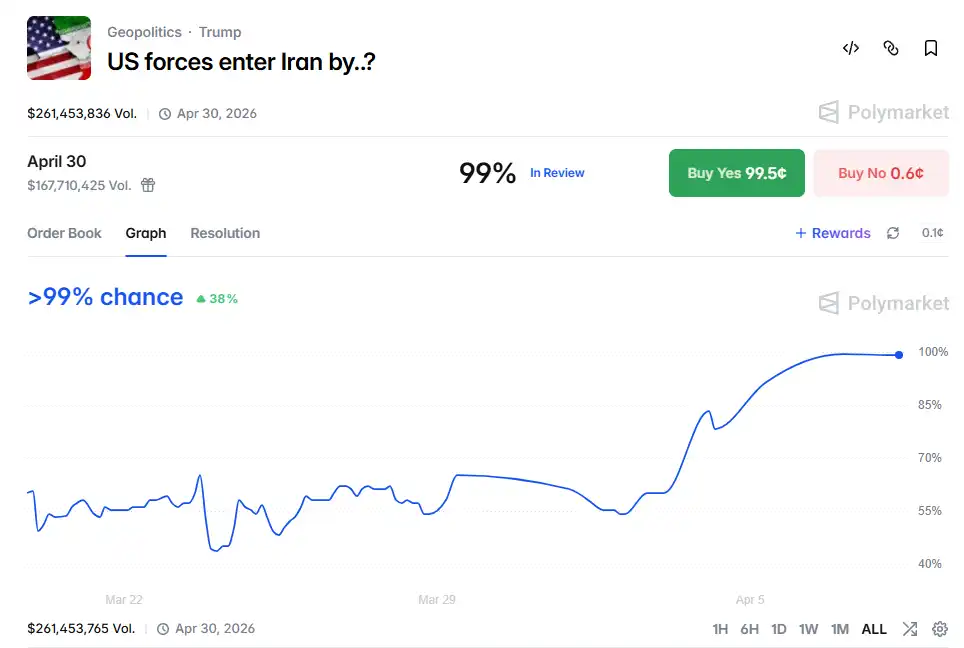
According to the settlement rules, active-duty U.S. military personnel (including special operations forces) entering Iranian land territory before a specified date would be considered an invasion, with the downed pilot not counting as an invasion, but U.S. special forces did indeed enter Iranian territory to rescue the pilot. Therefore, the special forces entering Iran to rescue the pilot met the standard for determining the U.S. invasion of Iran as Yes on Polymarket.
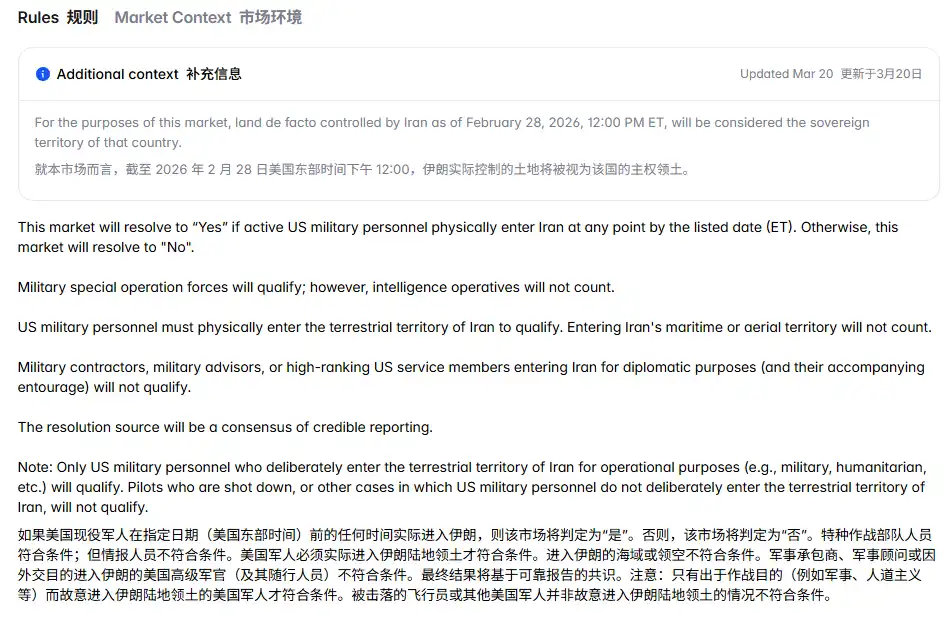
The "Pilot Rescue" event has been judged by Polymarket as the U.S. invasion of Iran, sparking strong community controversy.
Supporters of the "Count as Entry" (Yes side) believe that this action meets the definition of "entry" as per the rules. The U.S. Special Forces actively entered Iranian territory to carry out a mission, and the rules explicitly state that "special operation forces will qualify," including "for operational purposes (including humanitarian)." From an objective standpoint, this is the first confirmed U.S. ground penetration behavior in the current conflict context, with U.S. personnel indeed stepping on Iranian soil, hence should be considered an "entry."
Opponents of the "Count as Entry" (No side) argue that this definition is overly broad. They believe that this action was essentially a short-term, limited humanitarian rescue operation, not an invasion or occupation, and does not align with the general understanding of the public regarding "U.S. troops entering Iran."
Furthermore, the rules explicitly exclude that "pilots who are shot down... will not qualify," and this action revolves around the downed pilot, having the nature of "forced entry," which logically should fall into a similar exception category. Referring to past cases (such as similar regional actions not being considered invasions), rescue actions should not be equated with military entry; if judged as Yes, it may encourage marginal interpretations of the rules, weakening the seriousness and consistency of the market.
The Chinese community also generally believes that "entering Iran" should more specifically refer to large-scale ground or amphibious operations, rather than short-term actions of "rescue and leave."
Predict.fun: Polymarket Issuing Stablecoin Deemed as Token Launch
On the evening of April 6, Polymarket officially announced on X that it would undergo a comprehensive platform upgrade:
Rebuilding the trading engine, upgrading smart contracts; introducing a new native collateral token, Polymarket USD (1:1 pegged to USDC, to replace USDC.e, reducing bridging risks).
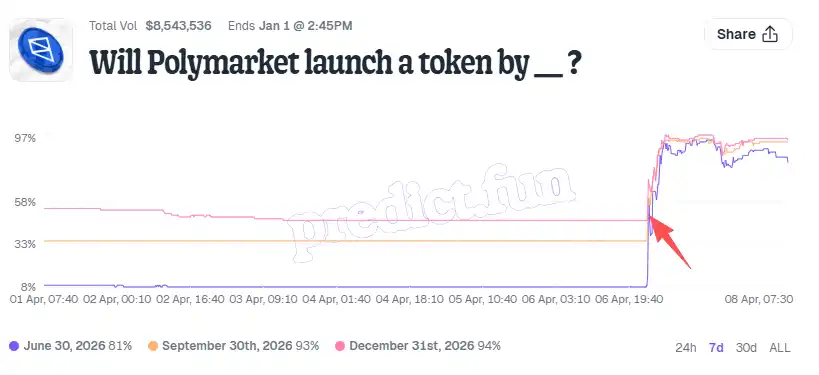
Notably, the second point mentioned the launch of the native collateral token Polymarket USD, directly impacting the probabilities of two related prediction events on Predict.fun.
One is token launch; the other is post-launch market cap:
1. When will Polymarket launch a token (Will Polymarket launch a token by ___ ?).
2. One day after opening, what was the FDV of Polymarket (Polymarket FDV above ___ one day after launch?)?
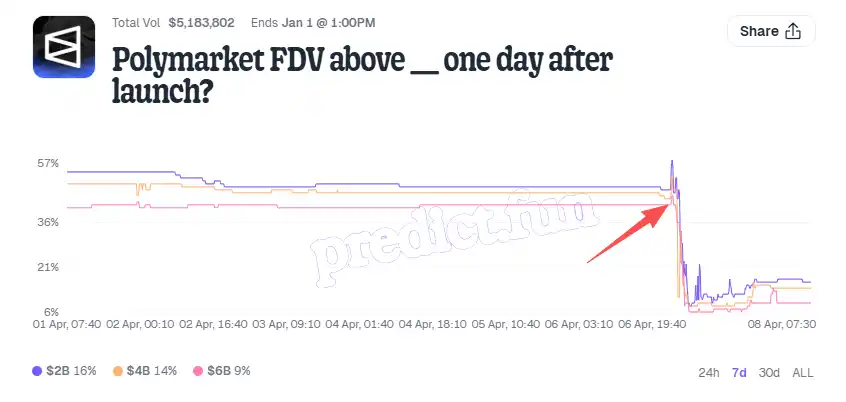
According to the settlement rules document, it is clearly stated that "any fungible token issued by Polymarket counts as 'issuance' for this event," and stablecoins are no exception. Therefore, Polymarket's stablecoin meets the criteria to be judged as Yes.
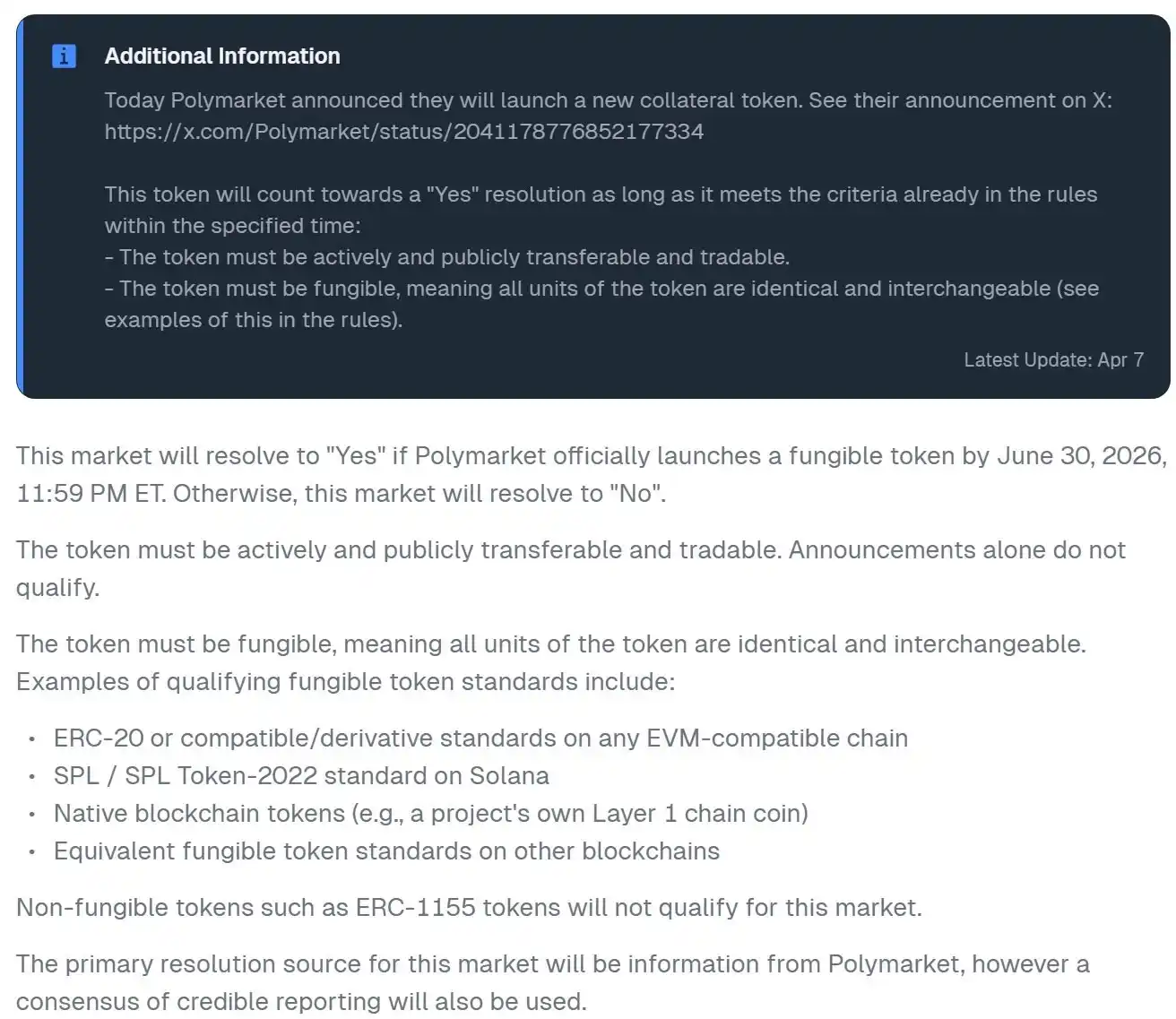
Settlement Rules Explanation
The community has engaged in a debate on this matter.
Supporters argue that based on the literal interpretation of the rules, "token issuance" is not limited to being a "governance token," but is a general reference to all tokens. Under this premise, Polymarket USD, as an ERC20/SPL fungible token issued by Polymarket, fundamentally meets the definition of "issuance." Furthermore, subsequent official clarifications are more of a reiteration of the original rules rather than a temporary rule change, making them somewhat reasonable in terms of compliance.
However, skeptics do not accept this explanation. On the one hand, they believe that including stablecoins in the category of "issuance" is an overinterpretation of the rules and a typical play on words. On the other hand, even if stablecoins are considered "issuance," the core of this prediction market is still the "Polymarket FDV," not the "Polymarket USD FDV." Stablecoins serve more as collateral or settlement tools, and their market value structure differs fundamentally from that of the project's native token (such as the POLY governance token), so they should not be directly equated or substituted for the overall project valuation logic.
Whose Side Are You On?
Overall, the controversial event in the prediction market actually revolves around a central question: are you betting on "reality" or on "rules"? Many times, these two do not completely overlap.
For those of us involved in prediction markets, understanding the rules themselves may be more important than predicting the outcome. How the information source is defined, whether there are any exceptions, whether there is room for interpretation—these details can directly determine the outcome at critical moments.
It is also for this reason that some high-probability events that appear to be a "financial management trap" may not be without risk, but may instead be a potential "loss trap." Many reversals occur precisely in these overlooked details. Instead of blind betting, take a closer look at the rules. It is more useful to do so than to complain after losing money.
You may also like

Why does OKX want to start a new company with the parent company of the New York Stock Exchange?

The interim executive director of the Ethereum Foundation speaks out: What is our mission?

Standard Chartered Bank sings a 50x rhapsody again, aiming for AAVE to reach 3500 USD
Tidal Investment: We still have a positive outlook on the AI industry chain, but the reasons have changed

Former SpaceX engineer reconstructs the financial execution system using first principles

Why Is PAXG Price Different From Gold? 5 Reasons Crypto Traders Should Know

The cryptocurrency industry has entered the "Show Me" era: merely relying on vision is no longer enough

WEEX OpenAPI 101: 5 Powerful Modules, AI Trading Tools, and Grab Up to 70% Revenue Opportunities
Learn how WEEX OpenAPI connects traders, developers, AI agents, and trading platforms. Discover WEEX API features, Binance-compatible integration, automated trading workflows, revenue opportunities, and ecosystem possibilities.

Morning News | The draft amendment to the People's Bank of China Law aims to clarify the legal status of digital renminbi; South Korea will transfer about 40 unregistered virtual asset service providers to law enforcement agencies

Interpreting the Ethereum Foundation's new structure: Reaffirming self-sovereignty amid institutional trends

Interview with NDV Founder Jason Huang: Popping the AI Bubble and the Myth of Microstrategy, Seeking the Ultimate Ace in the Crypto Market
Morning Report | Former Ethereum Foundation researcher establishes Ethlabs; EU Parliament Economic Committee passes digital euro regulatory proposal

Dragonfly partner Haseeb: The fastest-growing companies in the future may all be stuck at 149 people

How xBubble Breaks the Deadlock in VC's Heavy Investment in the OPC Economy

The encrypted unicorn Blockstream is deeply embroiled in a serious fraud case

Morning Report | The South Korean Financial Services Commission plans to expand the regulatory sandbox to include virtual assets; the parent company of the New York Stock Exchange, ICE, has reached a partnership with OKX to jointly establish a cryptocu...

Exclusive Interview with Strategy CEO: Putting Aside the Sale of 32 BTC, the 60 Trillion AI Intelligence is the Ultimate Fate of Bitcoin

TRON revitalizes the image of the bull, creating a more approachable brand character
Why does OKX want to start a new company with the parent company of the New York Stock Exchange?
The interim executive director of the Ethereum Foundation speaks out: What is our mission?
Standard Chartered Bank sings a 50x rhapsody again, aiming for AAVE to reach 3500 USD
Tidal Investment: We still have a positive outlook on the AI industry chain, but the reasons have changed
Former SpaceX engineer reconstructs the financial execution system using first principles
Why Is PAXG Price Different From Gold? 5 Reasons Crypto Traders Should Know


